
Results
-
 £21.95
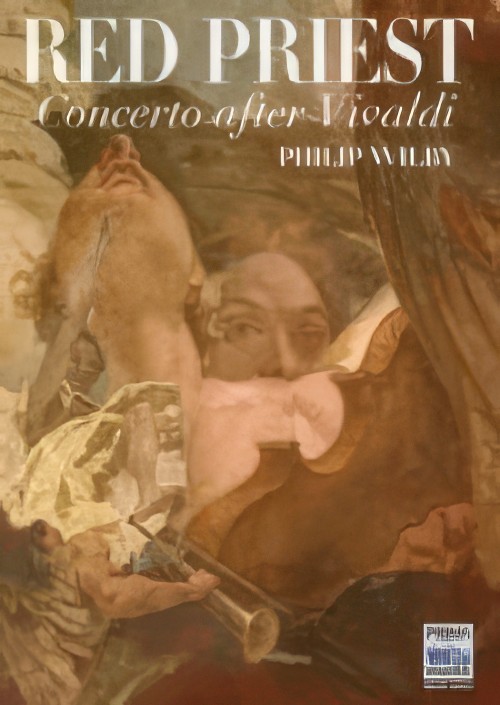
Red Priest (Brass Band - Study Score) - Wilby, Philip
Concerto After VivaldiDuring his lifetime, Antonio Vivaldi was known as 'il Prete Rosso', the Red Priest, thanks to his youthful ordination and his flaming red hair. The son of a violinist at San Marco in Venice, Vivaldi's musical pedigree was impeccable and an excellent start to his career was coupled with astounding energy and productivity. His vast output of concerti grossi, using soloists in groups, inspired this composition and performers may choose appropriate stage positions for the various groupings of cornets and trombones, spaced around the performance area. The score quotes freely from some of Vivaldi's most popular compositions, including 'Winter' from The Four Seasons, the motet Nisi Dominus, the famous Gloria and the fugue from the Concerto grosso in D minor found in L'Estro Armonico.However, it is the musical spirit of Vivaldi, a close contemporary of both Handel and Casanova, that inspired this music, which should be played with a mixture of accuracy and abandoned virtuosity. The musical images in this piece have clear associations in the composer's mind with individual Venetian locations, ranging from bustling street scenes to vaulted interiors, and describing the famous journey down the Grand Canal, past the Doge's Palace, to the Ospedale della Pieta where Vivaldi worked for so many years.Duration: 14.00
Estimated dispatch 7-14 working days
-
 £21.99
The Chronicles of Narnia (Brass Band - Score only)
The Disney hit movie The Chronicles of Narnia tells the story of four children who travel through a magical wardrobe to the land of Narnia and learn of their destiny to free it with the guidance of a talking lion. Much of the fantastic mystical atmosphere of the movie comes from Harry Gregson-Williams fantastic soundtrack. This medley features the highlights of the original soundtrack and it is sure to be a magical success in any concert. 06:25
Estimated dispatch 7-14 working days
-
 £21.50
ENTERTAINER, THE (Euphonium Duet and Brass Band) - Joplin, Scott - Fretwell, David
This classic rag has been arranged here for Euphonium Duet with Brass Band accompaniment. A great way to feature your Euphoniums!
Estimated dispatch 7-14 working days
-
£21.99
Pirates of the Caribbean: Dead Man's Chest (Brass Band - Score only)
The atmosphere of the brilliant and successful Walt Disney film Pirates of the Caribbean - Dead Man's Chest was partly defined by the exciting, dramatic and powerful soundtrack by Hans Zimmer. With this excellent arrangement of his memorable themes, the adventure comes to life all over again! Take your band on a high seas adventure with this swashbuckling medley. 06:59
Estimated dispatch 7-14 working days
-
£21.50
THE WIND BENEATH MY WINGS (Solo Trombone TC/BRASS Band)
There is also a Brass Band version only.
Estimated dispatch 7-14 working days
-
 £125.00
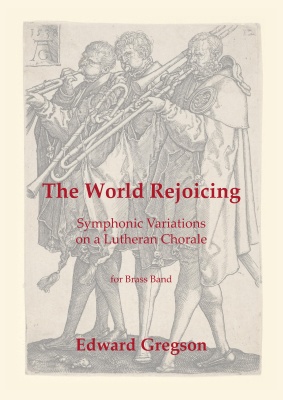
The World Rejoicing (Brass Band - Score and Parts)
The World Rejoicing was commissioned by the National Brass Band Associations of Belgium, Netherlands, Norway, Switzerland, and the British Open, as the test piece for their competitions in 2020/21. Although the work was completed in 2019, the pandemic of 2020 meant that these competitions were postponed until 2021/22. The premiere took place in September 2021 at Symphony Hall, Birmingham, UK.In searching for a common link between the brass band traditions of the various European countries that commissioned this work, I considered the fact that hymns have always played an important role in the relationship that brass bands have with their particular communities; and thus I turned to a well- known Lutheran chorale, Nun danket alle Gott (Now thank we all our God), written around 1636 by Martin Rinkart, with the melody attributed to Johann Cruger. A number of composers have incorporated this chorale into their music, most famously J.S. Bach in his Cantatas no. 79 and 192, and Mendelssohn in the Lobsegang movement of his 2nd Symphony (the harmonisation of which is usually used when this hymn is sung).It seemed fitting therefore for me to return to a compositional form I have used many times before (Variations) and to write a work based on this hymn. I have used it in a similar way to that which I employed in my Variations on Laudate Dominum of 1976 - that is, rather than writing a set of variations using elaborations of the complete tune, I have taken various phrases from the chorale and used them within the context of other musical material, applying an overall symphonic process of continuous variation and development. The structure, or sub-divisions of the work, which is through composed and plays without a break, is as follows:Prelude, Capriccio, La Danza 1, Processional, La Danza 2, Arias and Duets, Fuga Burlesca, Chorale, and Postlude.The work, which is around 16 minutes in length, is also partly autobiographical - in the manner say of Strauss's Ein Heldenleben - in that I have incorporated into the score brief quotations from many of my other major works for brass band. In that respect, The World Rejoicing sums up a particular facet of my life as a composer, and reflects the admiration I have always had for what is surely one of the great amateur music-making traditions in the world.Duration: 16.00
Estimated dispatch 7-14 working days
-
£40.00
The World Rejoicing (Brass Band - Score only)
The World Rejoicing was commissioned by the National Brass Band Associations of Belgium, Netherlands, Norway, Switzerland, and the British Open, as the test piece for their competitions in 2020/21. Although the work was completed in 2019, the pandemic of 2020 meant that these competitions were postponed until 2021/22. The premiere took place in September 2021 at Symphony Hall, Birmingham, UK.In searching for a common link between the brass band traditions of the various European countries that commissioned this work, I considered the fact that hymns have always played an important role in the relationship that brass bands have with their particular communities; and thus I turned to a well- known Lutheran chorale, Nun danket alle Gott (Now thank we all our God), written around 1636 by Martin Rinkart, with the melody attributed to Johann Cruger. A number of composers have incorporated this chorale into their music, most famously J.S. Bach in his Cantatas no. 79 and 192, and Mendelssohn in the Lobsegang movement of his 2nd Symphony (the harmonisation of which is usually used when this hymn is sung).It seemed fitting therefore for me to return to a compositional form I have used many times before (Variations) and to write a work based on this hymn. I have used it in a similar way to that which I employed in my Variations on Laudate Dominum of 1976 - that is, rather than writing a set of variations using elaborations of the complete tune, I have taken various phrases from the chorale and used them within the context of other musical material, applying an overall symphonic process of continuous variation and development. The structure, or sub-divisions of the work, which is through composed and plays without a break, is as follows:Prelude, Capriccio, La Danza 1, Processional, La Danza 2, Arias and Duets, Fuga Burlesca, Chorale, and Postlude.The work, which is around 16 minutes in length, is also partly autobiographical - in the manner say of Strauss's Ein Heldenleben - in that I have incorporated into the score brief quotations from many of my other major works for brass band. In that respect, The World Rejoicing sums up a particular facet of my life as a composer, and reflects the admiration I have always had for what is surely one of the great amateur music-making traditions in the world.Duration: 16.00
Estimated dispatch 7-14 working days
-
 £0.99
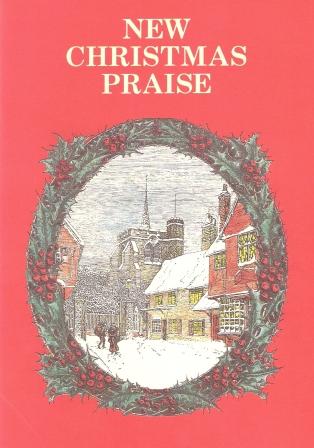
£0.99New Christmas Praise Song Book 1 - 95
These books are now an archive publication and, although are still available, have been superseded by Christmas Collection (available in marchcard size: https://www.sps-shop.com/cc-marchcard or A4 size https://www.sps-shop.com/cc-largeprint). Christmas Collection includes 46 new carols and songs as well as 10 extended carols (originally seen in the Sounds of Christmas books).Ideal for congregational singing.CONTENTS 1. A child this day is born 2. A Christmas Lullaby 3. A great and mighty wonder 4. A starry night 5. A virgin most pure 6. All my heart this night rejoices 7. Angels from the realms of Glory (Come and worship) 8. Angels from the realms of Glory (Iris) 9. Angels, sing again? 10.Angels we have heard on high 11.As with gladness men of old 12. Away in a manger 13. Away in a manger (The manger scene) 14. Bethlehem 15. Brightest and best 16. Brightest and best (Spean) 17. Child of Mary 18.. Calypso Carol 19. Carol for the Nativity 20. Carol of the bells 21.Carol of the drum 22. Christ was born on Christmas Day 23. Christians Awake 24. Come, children, come quickly 25. Coventry carol 26. Do you hear what I hear 27. Ding dong! merrily on high 28. Gabriels message 29. Glory in the highest 30. Go, tell it on the mountain 31. God of God, the uncreated 32. God rest you merry, gentlemen 33. Good Christian men, rejoice 34. Good King Wenceslas 35. Hark the glad sound! 36. Hark! the herald angels sing 37. How far is it to Bethlehem 38. I saw three ships come sailing in 39. I wonder as I wander 40. Il est n 41. Immanuel Appears 42. In the bleak mid-winter 43. Infant Holy 44. It came upon the midnight clear (Traditional) 45. It came upon the midnight clear (Willis) 46. Jesus, good above all other 47. Joy to the world 48. Little baby Jesus 49. Little Jesus, sweetly sleep. 50. Little donkey 51. Long, long ago 52. Marys boy child 53. Masters in this hall 54. Noel 55. o come, all ye faithful 56. o come, Immanuel 57. O come with me to Bethlehem 58. O little town of Bethlehem (Christmas Carol) 59. O little town of Bethlehem (Forest Green) 60. O little town of Bethlehem (St Louis) 61. O Heaven-sent King 62. O holy night 63. Once, in royal Davids city 64. Past three oclock 65. Personent hodie 66. Praise ye the Lord 67. Rise up, shepherd! 68. Sans day carol 69. See, amid the winters snow 70. Silent night! 71. Sleep, holy Babe 72. Softly the night is sleeping 74. Stars are shining 73. Sussex carol 76. Sweet chiming bells 75. Sweet chiming Christmas bells 77. The angels sang the story 78. The first Nowell 79. The holy Boy 80. The holly and the ivy 81. The infant King 82. The shepherds farewell 83. The virgin Mary had a baby boy 84. The stable door 85. They all were looking for a king 86. Three kings march 87. Unto us a boy is born 88. Wayfaring 89. We gather round the manger-bed 90. We three kings of Orient are 91. What child is this 92. When wise men came seeking 93. While shepherds watched 94. Who is he 95. Zither carol
Estimated dispatch 7-14 working days
-
 £33.62
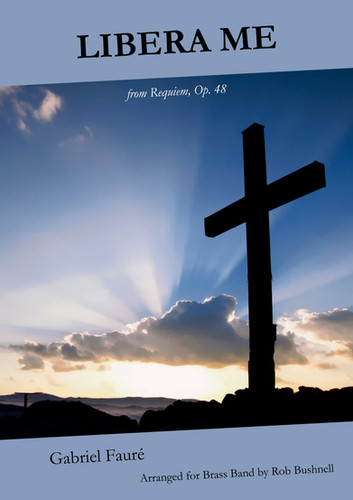
Libera Me from 'Requiem' (Brass Band) Faure arr. Rob Bushnell
Composed between 1887 and 1890, Gabriel Faure's Requiem is not only one of his best-known works but one of the most popular piece of choral music in the Classical repertoire, coming 23rd in the Classic FM's Hall of Fame 2024. Believed to be a tribute to his father (who died in 1885), Faure himself said "My Requiem wasn't written for anything - for pleasure, if I may call it that!" It started life as a five-movement work but was later expanded to be the final seven-movement work we know today. The first version (which Faure called "un petit Requiem") was first performed on 16 January 1888, with Faure conducting, a second version premiered on 21 January 1893 before the final version (reworked for full orchestra) was played on 12 July 1900; the Requiem was performed at the composer's own funeral in 1924.The Libera Me, or Deliver Me, was actually written in 1877 and is the sixth part of the Requiem.Faure once said of the work, "Everything I managed to entertain by way of religious illusion I put into my Requiem, which moreover is dominated from beginning to end by a very human feeling of faith in eternal rest." Upon interview, he also said, "It has been said that my Requiem does not express the fear of death and someone has called it a lullaby of death. But it is thus that I see death: as a happy deliverance, an aspiration towards happiness above, rather than as a painful experience. The music of Gounod has been criticised for its inclination towards human tenderness. But his nature predisposed him to feel this way: religious emotion took this form inside him. Is it not necessary to accept the artist's nature? As to my Requiem, perhaps I have also instinctively sought to escape from what is thought right and proper, after all the years of accompanying burial services on the organ! I know it all by heart. I wanted to write something different."This arrangement is for the British-style brass band, with alternative parts for horns in F and bass-clef lower brass. The tenor solo is featured on the euphonium. A recording of the original composition can be found here: www.youtube.com/watch?v=fXwFNoBHCf0 Duration: 4.20 minutes approx. Difficulty Level: 4th Section + PDF download includes parts and score. Sheet music available from www.brassband.co.uk Instrumentation: Soprano Cornet Eb Solo Cornet Bb Repiano Cornet Bb 2nd Cornet Bb 3rd Cornet Bb Flugel Horn Bb Solo Horn Eb 1st Horn Eb 2nd Horn Eb 1st Baritone Bb 2nd Baritone Bb 1st Trombone Bb 2nd Trombone Bb Bass Trombone Euphonium Bb Bass Eb Bass BbTimpani
In Stock: Estimated dispatch 1-3 working days
-
 £10.00
Endurance
DescriptionMen wanted for hazardous journey. Small wages, bitter cold, long months of complete darkness, constant danger, safe return doubtful. Honour and recognition in case of success. - Ernest Shackleton, 4 Burlington StreetEndurance takes its title from the ship used by Sir Ernest Shackleton's Imperial Trans-Antarctic Expedition in 1914-15. After many months of fundraising (and reputedly running the above advert in The Times) the Endurance set sail from Plymouth on 6 August 1914. Whilst at sea news of the outbreak of war led Shackleton to put his ship and crew at the disposal of the Admiralty, but their services were not required and they were encouraged to continue. On October 26 1914 they left Grytviken on South Georgia for the Antarctic continent, hoping to find the pack ice shrinking in the Antarctic spring. Two days later, however, they encountered unseasonable ice which slowed their progress considerably. On 15 January 1915, when Endurance was only 200 miles from her intended landfall at Vahsel Bay, the ship became beset by ice which had been compressed against the land to the south by gale force winds. Trapped in the ice of the Weddell Sea, the ship spent the Antarctic winter driven by the weather further from her intended destination until, on 21 November 1915 Endurance broke up forcing the crew to abandon ship and set up camp on the ice at a site they named "Patience Camp".The crew spent several weeks on the ice. As the southern spring started to reduce the extent of the ice shelf they took to their three lifeboats, sailing across the open ocean to reach the desolate and uninhabited Elephant Island. There they used two of the boats to build a makeshift shelter while Shackleton and five others took the largest boat, an open lifeboat named the 'James Caird' and sailed it for 800 terrifyingly dangerous miles across the vast and lonely Southern Atlantic to South Georgia - a journey now widely regarded as one of the greatest and most heroic small-boat journeys ever undertaken. After landing on the wrong side of the island and having to climb over a mountain range in the dark with no map, Shackleton and his companions finally stumbled back into the Grytviken whaling station on 19 May 1916.After resting very briefly to recover his strength, Shackleton then began a relentless campaign to beg or borrow a ship to rescue the rest of his crew from Elephant Island; whaling ships were not strong enough to enter polar ice, but on 30 August 1916, over two years after their departure from Plymouth, Shackleton finally returned to Elephant Island aboard a steam tug borrowed from the Chilean government. Although some were in poor health, every member of the Endurance crew was rescued and returned home alive.Endurance is dedicated to the memory of my mum, who passed away in September 2017.Listen to a computer generated preview and follow the score below:
Estimated dispatch 7-14 working days
 View Music